A Lightning-First Look at Our Contenders
Both games are masters of minimalist design and maximum adrenaline, but they achieve it through different paths.
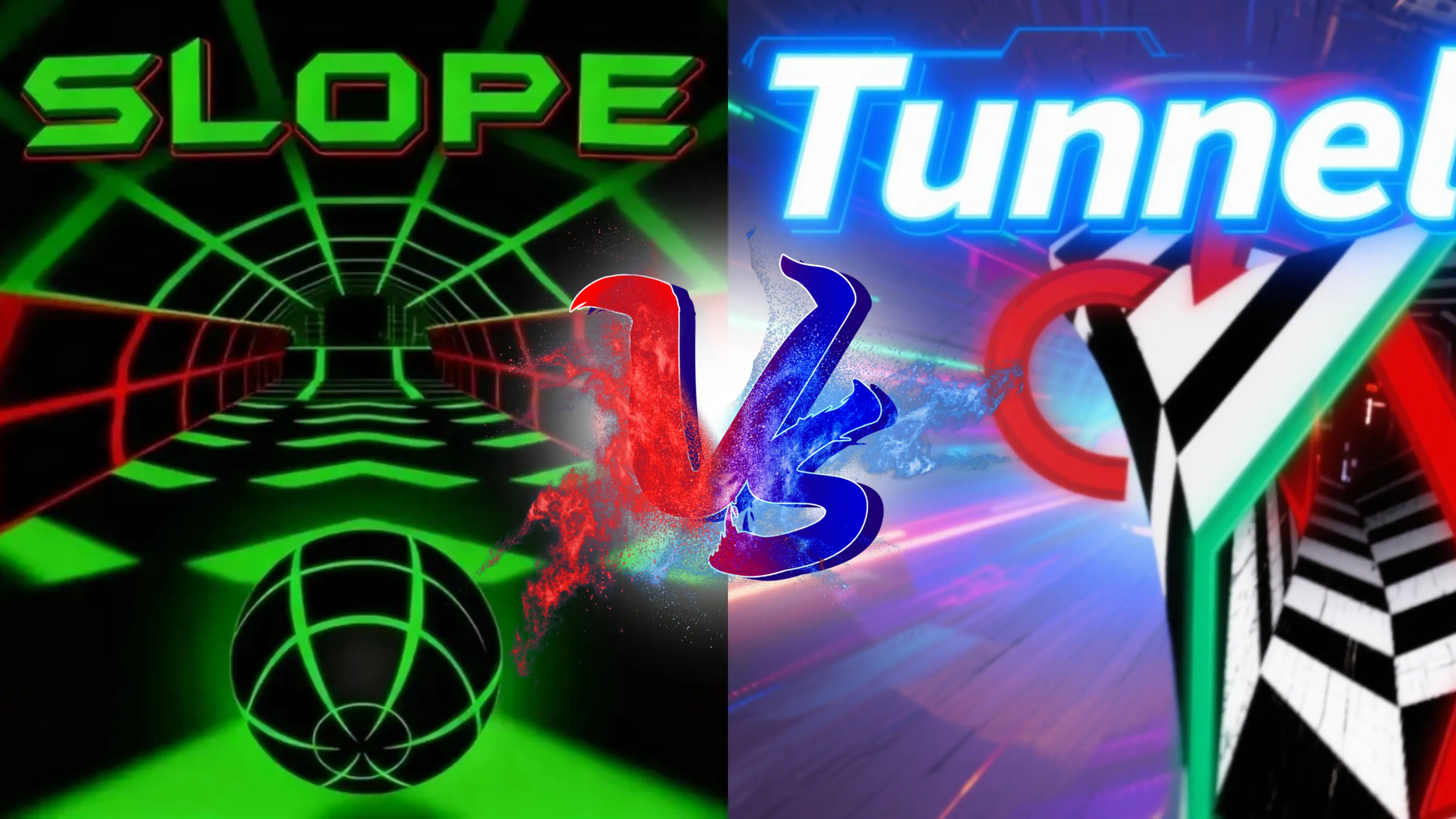
Tunnel Rush throws you into the heart of a neon-drenched, geometric nightmare. You are a small cube or ball hurtling forward through an endless, twisting tunnel. The sole objective is survival---avoid every obstacle. The tunnel is filled with brightly colored barriers that spin, shift, and materialize with almost no warning. The only control you have is moving left and right (and sometimes up and down) to navigate the ever-shrinking safe path. The speed is blistering from the first second, creating an overwhelming sensory overload that perfectly simulates the feeling of a high-speed chase through a futuristic obstacle course.
Slope Game, on the other hand, trades the claustrophobic tunnel for an open, vertigo-inducing slope. You control a ball rolling down a seemingly infinite, procedurally generated 3D course. Your goal is to stay on the track. The challenge comes from the unpredictable, jagged geometry of the slope itself. As you descend, the speed increases relentlessly. The track banks sharply, drops suddenly, and is littered with red block obstacles. The physics are unforgiving; a slight overcorrection can send your ball careening off the edge into the abyss. While Tunnel Rush feels like a predetermined assault, Slope Game feels like a desperate fight for control against gravity and momentum.
Breaking Down the Difficulty: A Multi-Layer Analysis
To truly understand which game is harder, we need to look at the distinct types of challenges they present.
The Primary Challenge: Pattern Recognition vs. Physics Control
This is the fundamental split between the two games.
Tunnel Rush is primarily a test of visual processing and pattern recognition. The difficulty lies in your brain's ability to instantly decode the complex, overlapping shapes flying toward you and translate that into a precise movement. The obstacles often form rhythmic sequences or symmetrical patterns. High-level play involves recognizing these patterns early and executing a pre-planned movement path. However, the game can also throw visual tricks, using light, color, and perspective to disguise the real safe route. Your enemy here is optical illusion and information overload.
Slope Game is a supreme test of physics intuition and micro-adjustments. The track is randomized, so you cannot memorize it. The core skill is "reading" the slope's upcoming angles and understanding how your ball's momentum will interact with it. A shallow curve requires a gentle nudge; a sharp drop followed by a hard bank demands a quick, decisive correction. As the official guide states, the ball can feel uncontrollable after a steep drop, and the key is to use "minimal, gentle corrections to regain control without oversteering." Your enemy here is momentum and the ever-tightening margin for error.
The Speed and Progression: Relentless vs. Escalating
How the games increase pressure is another key differentiator.
In Tunnel Rush, the speed is often near-maximum from the outset. The challenge progression comes from the increasing complexity of the obstacle patterns. The tunnel itself may warp more drastically, the safe paths may become thinner, and the colors may become more disorienting. The "difficulty curve" is more about cognitive complexity than raw speed.
In Slope Game, the initial pace is manageable, but the defining feature is its relentless and continuous acceleration. The game is engineered so that "speed increases continually, making survival progressively more difficult." This creates a unique psychological pressure. The maneuvers that worked at 30 seconds become impossible at 90 seconds. Your skills are stress-tested in real-time, and the game systematically pushes you beyond your comfort zone until you make a mistake. This escalating tension is a core part of its brutal charm.
The Control Scheme: Precision vs. Finesse
Both games use simple left/right controls, but the feel and required touch are worlds apart.
Tunnel Rush demands binary, snap-decision precision. You are often threading a needle between static barriers. The movement is less about smoothness and more about hitting the exact correct pixel at the exact correct millisecond. There is little room for drifting or adjustment mid-maneuver.
Slope Game requires constant, fluid finesse. As the tips suggest, you must make "small adjustments" and try to "stay centered." Holding a key too long guarantees a crash. It's about maintaining a delicate balance, constantly feathering the controls to counteract the slope's twists and the ball's own inertia. This need for continuous, subtle input can be more mentally taxing over a long run than Tunnel Rush's series of quick reactions.
The Verdict: Which Game Is Objectively Harder?
The answer depends on your definition of "hard" and your personal skillset.
Choose Tunnel Rush if you want to test your raw reaction time and visual processing speed. It is the purer reflex test. It is harder in a short, intense burst. If you excel at rhythm games or bullet-hell shooters where dodging dense patterns is key, you might find Tunnel Rush's challenge more direct and conquerable. Its difficulty is front-loaded in your sensory perception.
Choose Slope Game if you want to test your sustained focus, predictive control, and composure under escalating pressure. It is the harder game to master in the long run. The combination of randomized tracks, punishing physics, and ever-increasing speed creates a challenge that is less about a single mistake and more about the inevitable breakdown of your skill under pressure. A high score in Slope Game represents a longer period of flawless, adaptive control, which many players find to be a more significant achievement.
For most players, especially those aiming for high scores, Slope Game presents the higher and more sustained difficulty ceiling. The reason is its core, unforgiving mechanic: the speed never stops increasing. There is a theoretical limit to human reaction time that Tunnel Rush eventually hits. Slope Game, with its accelerating speed and physics-based control, creates a challenge that becomes *logistically* impossible, not just very fast. You are not just fighting the course; you are fighting a fundamental force (speed) that will eventually outpace any human's ability to react.
Pro Tips to Conquer Both Games
For Tunnel Rush
- Focus on the Center: Try to look at the center of the screen, not the obstacles rushing at the edges. Your peripheral vision will catch the patterns.
- Find the Rhythm: Many obstacle sets are timed. Listen and feel for a beat to anticipate the next shift.
- Practice Specific Sections: If a particular pattern always kills you, play just to get to that part and drill it until your muscles remember the move.
For Slope Game
- Minimalist Input is Key: Heed the game's own advice. "Only use the Left/Right keys for subtle steering. Overcorrecting will likely send you off the edge."
- Look Ahead, Not Down: Don't stare at your ball. Constantly scan the track 2-3 turns ahead to prepare for the upcoming geometry.
- Anticipate, Don't React: Plan your path. See a sharp left turn after a drop? Start your gentle move left *before* you hit the drop to use the momentum to your advantage.
Frequently Asked Questions (FAQ)
Q: Which game is better for quick, short sessions?
A: Tunnel Rush is perfect for quick bursts. Runs are typically very short, and the intensity is immediate. Slope Game runs can last longer as you build skill, making it better for a slightly extended challenge.
Q: I get dizzy easily. Which game should I avoid?
A: Tunnel Rush is a major culprit for motion sickness or visual overload due to its spinning, colorful tunnel. Slope Game's more open 3D space can also be disorienting but is generally less intense on the eyes for most people.
Q: Which game has a higher skill ceiling for world records?
A: Slope Game likely has a higher practical skill ceiling. Because the speed increases infinitely and the track is random, there is no "perfect run." Pushing a record higher is always about maintaining control at speeds that were previously unmanageable.
Q: Can I play these on a school or work computer?
A: Yes! Both games are featured on platforms like PUZ.GG specifically as "unblocked games," meaning they are hosted on sites designed to be accessible on restricted networks. You can play them directly in your web browser without any downloads.
Q: Are the controls the same on mobile?
A: Both games are playable on mobile with touch controls. Tunnel Rush typically uses touch zones for left/right/up/down. Slope Game uses a touch-based tilting or sliding control. The precision required makes the PC version with a keyboard arguably easier for high scores.
The Ultimate Verdict: Which Game Truly Tests Your Limits?
In the epic duel of Tunnel Rush vs. Slope Game, the title of "Harder Game" goes to Slope Game for its ruthless, escalating, and physics-based challenge that tests not just your reflexes, but your composure and predictive skill over time.
However, this doesn't diminish Tunnel Rush's status as a legendary reflex destroyer. It is the ultimate test of pure, unadulterated reaction speed and pattern decoding. The best way to settle the debate? Play them both on PUZ.GG and experience the unique brand of adrenaline-fueled panic each one provides. Challenge your friends to beat your high score and discover for yourself where your personal gaming reflexes shine---or shatter.
Related Articles
ARC Raiders: The Ultimate Guide to Mastering the Three Core Skill Trees
Best 5 Clicker Games: Top Idle Games for School Fun in 2025
The Ultimate RV There Yet Guide: Essential Tips for Your Epic Road Trip